A Technical Comparison
Lawn edging plays a central role in garden design. It defines the transitions between lawns, paths, and flower beds and ensures that these areas retain their shape over time. A variety of materials are available, each differing significantly in terms of technical properties and design. Steel or plastic lawn edging is used particularly often.
A technical comparison highlights the properties of these materials and their impact on functionality, durability, and design.
Dimensional Stability and Load-Bearing Capacity
A key criterion for lawn edging is its dimensional stability. Transitions in the garden are constantly exposed to mechanical stress, such as from gardening tools, foot traffic, or soil pressure.
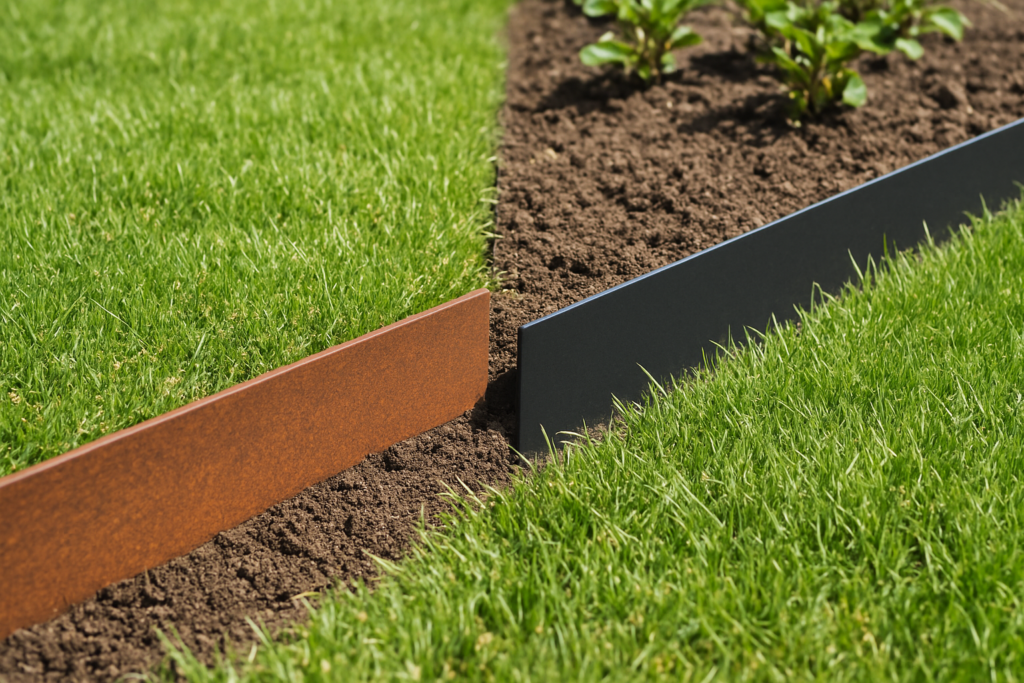
Steel lawn edging is characterized by its high stability. It retains its shape even over long lengths and across significant differences in elevation. Straight lines remain consistently precise, and curves can be created with precision.
Plastic lawn edging is more flexible, but it loses its original shape more quickly under stress. With prolonged use, it can warp or lift, especially in the event of temperature fluctuations or an uneven surface.
Durability and Weather Resistance
Outdoor areas place high demands on materials. Moisture, frost, heat, and UV radiation have a constant effect on lawn edging.
Steel lawn edging, particularly Corten steel lawn edging, is designed for long-term use. It is weather-resistant and retains its structural integrity for many years. Corten steel also forms a protective surface that permanently stabilizes the material.
Plastic is more susceptible to weathering. UV radiation can cause the material to become brittle, and frost can lead to cracks. Its service life is generally shorter, especially under heavy use.
Installation and Workmanship
Installing lawn edging affects both the function and the future maintenance of the garden.
Steel lawn edging is typically anchored firmly into the ground. It allows for precise height control and ensures clean, even transitions. Installation requires careful preparation but offers a durable, stable solution.
Plastic lawn edging is easier and faster to install. It is lighter and can be installed without special tools. However, these advantages often come at the expense of precision and long-term stability.
Design Impact
In addition to their technical function, lawn edging plays an important role in the visual appeal of a garden. Lawn edging is part of the garden's layout and influences its overall appearance.
Steel lawn edging blends discreetly into modern garden designs. It accentuates lines and transitions without appearing overpowering. Especially in cleanly designed gardens, it helps create a calm, architectural look.
Plastic lawn edging is more visually prominent and often appears less high-quality. Color changes over time can further detract from the overall design.
Conclusion
The technical comparison reveals clear differences between steel lawn edging—such as that offered by Mysteel —and plastic. Steel stands out for its dimensional stability, weather resistance, and understated aesthetic appeal. Plastic scores points for its ease of installation but does not offer the same durability.
For gardens where structure, precision, and long-term quality are the top priorities, steel lawn edging is the technically superior solution. It plays a key role in ensuring that transitions remain clearly defined over time and that the design stands the test of time.